
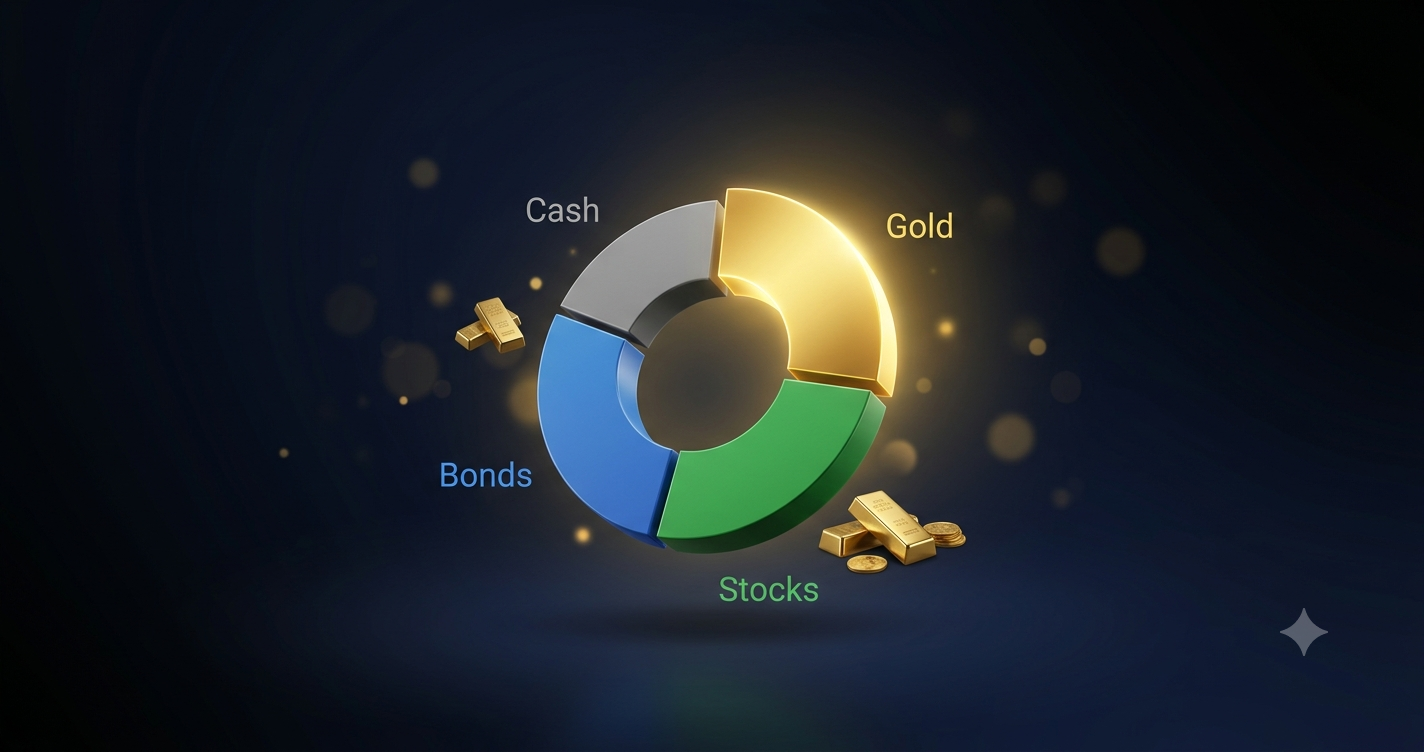
Confused about how much gold to hold in your portfolio? This guide breaks down the ideal gold investment portfolio allocation percentage based on risk profile, age, and financial goals.
Introduction
One of the most common questions new and experienced investors ask is: “How much gold should I actually have in my portfolio?” It’s a simple question, but the answer depends on several personal and market-related factors. Understanding the right gold investment portfolio allocation percentage can help you balance growth, protect against volatility, and build a more resilient long-term financial plan.
In this guide, we’ll explore why gold allocation matters, what percentage experts commonly recommend, how to adjust it based on your personal risk profile, and practical steps to implement it in your own portfolio.
Why Gold Allocation Matters in a Portfolio
Gold behaves differently from stocks, bonds, and other traditional assets. It often moves independently — or even inversely — to equity markets, especially during periods of economic stress, inflation, or currency devaluation. This makes gold a valuable diversification tool rather than a primary growth engine.
The goal of allocating a portion of your portfolio to gold isn’t to maximize returns on its own, but to:
- Reduce overall portfolio volatility
- Protect purchasing power during inflation
- Provide a hedge during market downturns or geopolitical uncertainty
- Balance out riskier, high-growth assets like stocks
Because gold doesn’t generate income (no dividends or interest), allocating too much can limit your portfolio’s long-term growth potential. Allocating too little, on the other hand, may leave your portfolio more exposed to market shocks. Finding the right balance is key.
What Percentage of Your Portfolio Should Be in Gold?
There’s no single “correct” answer, but financial advisors commonly reference a few general guidelines:
The Common 5% to 10% Rule
Many financial planners suggest allocating 5% to 10% of a portfolio to gold. This range is often seen as enough to provide meaningful diversification benefits without significantly limiting long-term growth potential.
The 10% to 15% Range for Conservative Investors
Investors who prioritize capital protection over aggressive growth — such as those nearing retirement — may consider a slightly higher allocation, typically in the 10% to 15% range, to reduce overall portfolio volatility.
Higher Allocations During Economic Uncertainty
During periods of high inflation, currency instability, or global economic stress, some investors temporarily increase their gold allocation beyond typical guidelines as a defensive measure. However, this is usually a tactical adjustment rather than a permanent strategy.
Key takeaway: While 5–15% is a commonly cited range, your ideal allocation should ultimately be based on your personal financial goals, risk tolerance, and investment horizon — not a fixed universal number.
Factors That Influence Your Ideal Gold Allocation
1. Age and Investment Horizon
Younger investors with longer time horizons often lean toward higher stock allocations for growth, keeping gold allocation on the lower end (around 5%). As investors approach retirement, increasing gold allocation slightly can help protect accumulated wealth from market volatility.
2. Risk Tolerance
Conservative investors who are uncomfortable with large portfolio swings may prefer a higher gold allocation for stability, while aggressive investors focused on growth may keep gold allocation minimal.
3. Overall Financial Goals
If your primary goal is long-term wealth accumulation, a lower gold allocation paired with higher equity exposure may align better. If your goal is capital preservation, a higher gold percentage may make more sense.
4. Current Economic Environment
During periods of high inflation or economic uncertainty, some investors temporarily adjust their allocation upward as a protective measure, then rebalance back to their long-term target once conditions stabilize.
5. Existing Portfolio Diversification
If your portfolio already includes other inflation-hedging or low-correlation assets (like real estate or commodities), your ideal gold allocation might be lower than someone with a purely stock-and-bond portfolio.
Sample Portfolio Allocation Models
Here are a few illustrative examples of how gold allocation might look across different investor profiles. These are general examples for educational purposes, not personalized financial advice.
Aggressive Growth Investor (Younger, Higher Risk Tolerance)
- Stocks: 75%
- Bonds: 15%
- Gold: 5%
- Cash/Other: 5%
Balanced Investor (Moderate Risk Tolerance)
- Stocks: 55%
- Bonds: 25%
- Gold: 10%
- Cash/Other: 10%
Conservative Investor (Nearing Retirement, Lower Risk Tolerance)
- Stocks: 35%
- Bonds: 40%
- Gold: 15%
- Cash/Other: 10%
These models illustrate how gold allocation typically increases as an investor’s focus shifts from growth toward capital preservation.
How to Determine Your Personal Gold Allocation
Step 1: Assess Your Risk Tolerance
Consider how comfortable you are with portfolio volatility. If market swings cause significant stress, a higher gold allocation may help smooth out returns.
Step 2: Define Your Investment Timeline
Longer timelines generally allow for more growth-focused allocations, while shorter timelines may benefit from increased stability through gold.
Step 3: Evaluate Your Existing Portfolio
Look at your current mix of stocks, bonds, real estate, and other assets to identify how much diversification you already have.
Step 4: Set a Target Allocation Range
Rather than a fixed number, consider setting a target range (e.g., 8–12%) that allows some flexibility based on market conditions.
Step 5: Rebalance Periodically
As gold and other asset prices fluctuate, your actual allocation percentage will drift over time. Periodic rebalancing — typically once or twice a year — helps maintain your intended allocation.
Ways to Achieve Your Gold Allocation
Once you’ve determined your target gold investment portfolio allocation percentage, there are several ways to implement it:
- Physical gold — coins, bars, or jewelry
- Digital gold — purchased and stored through fintech platforms
- Gold ETFs — traded like stocks, offering easy portfolio integration
- Gold mutual funds — professionally managed exposure to gold markets
- Sovereign gold bonds (where available) — government-backed instruments, sometimes with added interest
- Gold mining stocks — indirect exposure through companies involved in gold production
Each option has different liquidity, storage, and cost considerations, so the right choice depends on your convenience preferences and investment goals.
Common Mistakes in Gold Portfolio Allocation
1. Over-Allocating to Gold
Putting too much of your portfolio into gold can limit long-term growth, since gold doesn’t generate dividends or compound like stocks.
2. Under-Allocating or Ignoring Gold Entirely
Skipping gold allocation altogether can leave a portfolio more vulnerable to inflation and market volatility, especially during economic downturns.
3. Reacting Emotionally to Short-Term Price Moves
Sharply increasing or decreasing gold allocation based on short-term price spikes can disrupt a well-planned long-term strategy.
4. Failing to Rebalance
Without periodic rebalancing, gold allocation can drift significantly from your original target, especially during periods of high gold price volatility.
5. Choosing the Wrong Gold Investment Type
Selecting an illiquid or high-cost gold investment option without considering your needs (such as physical gold when you need quick liquidity) can create unnecessary friction.
How Often Should You Review Your Gold Allocation?
Most financial advisors recommend reviewing portfolio allocation, including gold holdings, at least once or twice a year, or whenever there’s a significant life change (such as approaching retirement) or major shift in financial goals. Regular reviews help ensure your gold allocation stays aligned with your evolving risk tolerance and objectives.
Final Thoughts
There’s no universal “correct” gold investment portfolio allocation percentage — the right amount depends on your individual risk tolerance, investment timeline, and financial goals. However, a commonly referenced range of 5% to 15% provides a useful starting point for most investors seeking diversification benefits without sacrificing long-term growth potential.
The key is to view gold not as a primary growth investment, but as a strategic stabilizer within a broader, well-diversified portfolio. By setting a thoughtful allocation target and reviewing it periodically, you can use gold effectively to balance risk while still pursuing your long-term financial objectives.
Frequently Asked Questions (FAQs)
1. What is the ideal gold allocation percentage in a portfolio?
Many financial advisors suggest 5% to 15%, depending on individual risk tolerance, age, and financial goals.
2. Should retirees have a higher gold allocation?
Retirees or those nearing retirement often lean toward the higher end of the range to prioritize capital protection over aggressive growth.
3. Is it risky to have too much gold in a portfolio?
Yes, over-allocating to gold can limit long-term growth potential since gold doesn’t generate dividends or compound returns like stocks.
4. How often should I rebalance my gold allocation?
Most experts recommend reviewing and rebalancing your portfolio, including gold holdings, at least once or twice a year.
5. Can I include multiple types of gold investments in my allocation?
Yes, many investors combine physical gold, digital gold, and gold ETFs to balance liquidity, cost, and convenience within their target allocation.
Disclaimer: This article is for informational and educational purposes only and should not be considered financial advice. Please consult a licensed financial advisor to determine the right portfolio allocation for your individual circumstances.