
Gold has held a unique place in human history for over 5,000 years. From ancient currencies to modern investment portfolios, it has consistently served as a symbol of wealth, security, and stability. Yet despite its long history, many people still find the world of gold confusing — karats, purity, spot prices, investment options, and market jargon can feel overwhelming to a newcomer.
This guide breaks it all down in simple terms, whether you’re buying your first piece of gold jewelry, considering gold as an investment, or simply want to understand how this precious metal actually works.
Why Gold Still Matters in the Modern World
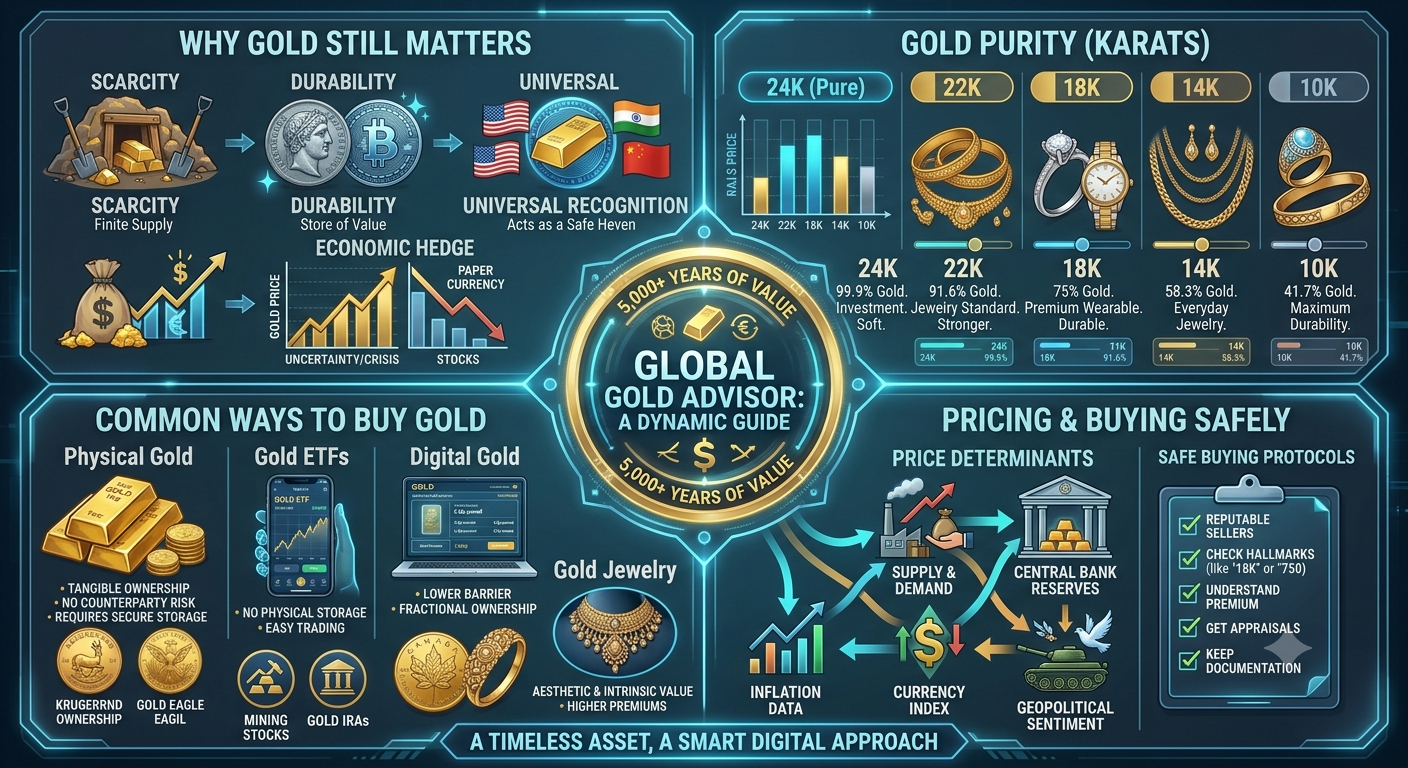
In an age of digital currencies, stock markets, and complex financial products, it might seem surprising that a shiny yellow metal still commands so much attention. But gold’s appeal comes from a few unique qualities that no other asset fully replicates.
First, gold is scarce. Unlike paper currency, which governments can print in unlimited quantities, the total supply of gold on Earth is finite and grows very slowly through mining. This scarcity gives it lasting value.
Second, gold doesn’t corrode, tarnish, or degrade over time. A gold coin minted centuries ago is still gold today, which is part of why it has remained a trusted store of value across cultures and generations.
Third, gold is universally recognized. Whether you’re in a small village or a major financial capital, gold carries value that transcends borders, languages, and political systems. This makes it a unique “global currency” that isn’t tied to any single country’s economy.
Finally, gold tends to perform well during times of uncertainty. When stock markets crash, currencies weaken, or geopolitical tensions rise, investors often turn to gold as a safe haven, which is why it’s frequently referred to as a hedge against economic instability.
Understanding Gold Purity: What Do Karats Mean?
One of the most confusing aspects of gold for beginners is the karat system, which measures purity. Here’s a simple breakdown:
- 24 Karat (24K): This is pure gold — 99.9% gold content with virtually no other metals mixed in. It’s soft, bright yellow, and primarily used for gold bars, coins, and investment-grade bullion. Because it’s so soft, it’s not ideal for everyday jewelry that needs to withstand wear and tear.
- 22 Karat (22K): Made up of about 91.6% gold, with the remainder typically alloyed with metals like copper or silver for added strength. This is a common standard for fine jewelry in many parts of the world.
- 18 Karat (18K): Contains roughly 75% gold. It strikes a balance between purity and durability, making it a popular choice for engagement rings and everyday wearable jewelry.
- 14 Karat (14K): About 58.3% gold, offering even greater durability at a lower cost, commonly used in more affordable jewelry pieces.
- 10 Karat (10K): The minimum purity in many countries to legally be labeled “gold,” at around 41.7% purity. It’s the most durable but has the least gold content.
Understanding karats matters because purity directly impacts both value and durability. Higher karat gold is worth more per gram but is softer and more prone to scratching or bending, while lower karat gold sacrifices some value for added strength.
Common Ways to Buy Gold
There isn’t just one way to own gold — different methods suit different goals, budgets, and risk tolerances.
1. Physical Gold: Bars and Coins
Buying gold bars or coins is the most traditional way to own the metal. This method offers direct, tangible ownership with no reliance on a third party. Popular options include government-minted coins and privately produced bars from reputable refiners.
The main advantages are full ownership and no counterparty risk — you physically hold the asset. The downsides include the need for secure storage, insurance costs, and the fact that buying and selling often comes with a premium above the raw spot price.
2. Gold Jewelry
Jewelry is often the most common entry point into owning gold for many people, blending aesthetic value with intrinsic worth. However, jewelry typically isn’t the most efficient way to invest in gold purely for financial reasons, since a significant portion of the price covers craftsmanship, design, and branding rather than the raw metal content.
3. Gold ETFs (Exchange-Traded Funds)
For those who want exposure to gold prices without dealing with physical storage, gold ETFs offer a convenient alternative. These funds are traded on stock exchanges just like shares, and their value is tied to the price of gold. This makes buying and selling extremely easy through a standard brokerage account.
4. Gold Mining Stocks
Investing in companies that mine and produce gold offers indirect exposure to gold prices. While these stocks can benefit from rising gold prices, they also carry additional risks tied to company management, production costs, and operational challenges that have nothing to do with the price of gold itself.
5. Gold IRAs and Retirement Accounts
Some investors choose to hold physical gold within specialized retirement accounts, allowing them to combine the tax advantages of retirement savings with the diversification benefits of precious metals. These accounts typically require the gold to be stored with an approved custodian rather than at home.
6. Digital Gold
A newer option in many markets, digital gold platforms allow buyers to purchase small fractional amounts of gold online, which is then stored securely on their behalf. This lowers the barrier to entry, letting people invest in gold with much smaller amounts of money than buying a full coin or bar would require.
What Determines the Price of Gold?
Gold prices move constantly, influenced by a mix of economic, political, and psychological factors:
- Supply and demand: Limited mining output combined with steady or growing demand naturally pushes prices upward over time.
- Central bank activity: When central banks buy large amounts of gold to diversify their reserves, it creates significant upward demand pressure.
- Inflation: Gold is often seen as a hedge against inflation, so rising prices for everyday goods can drive more investors toward gold.
- Currency strength: Since gold is typically priced in U.S. dollars internationally, a weaker dollar tends to make gold more attractive to global buyers, often pushing prices higher.
- Interest rates: Gold doesn’t pay interest or dividends, so when interest rates rise, other assets can become relatively more attractive, sometimes cooling gold demand.
- Geopolitical events: Wars, political instability, and global crises often send investors toward gold as a safe-haven asset, causing prices to spike during periods of uncertainty.
Tips for Buying Gold Safely
Whether you’re purchasing jewelry, coins, or bars, a few precautions can help ensure you’re getting genuine value:
- Buy from reputable sellers. Established, well-reviewed dealers or jewelers are far less likely to sell counterfeit or misrepresented gold.
- Check for hallmarks. Legitimate gold items are usually stamped with a purity mark (like “24K,” “22K,” “750” for 18K, etc.) indicating their gold content.
- Understand the premium. Physical gold almost always sells above the raw spot price to account for minting, distribution, and dealer margin — this is normal and expected.
- Get things appraised. For larger or more valuable purchases, an independent appraisal can confirm authenticity and fair pricing.
- Keep documentation. Receipts, certificates of authenticity, and appraisal documents are valuable if you ever decide to sell or insure your gold.
- Compare prices across sellers. Prices and premiums can vary meaningfully between dealers, so it pays to shop around before making a significant purchase.
Gold as Part of a Diversified Portfolio
Financial advisors often recommend holding a modest allocation of gold — commonly cited figures range from 5% to 10% of a portfolio — as a way to add diversification and reduce overall risk. Because gold often moves independently of stocks and bonds, and sometimes even in the opposite direction during market downturns, it can help smooth out portfolio volatility over time.
That said, gold isn’t without drawbacks as an investment. It doesn’t generate income the way dividend-paying stocks or interest-bearing bonds do, and its price can be volatile in the short term. It’s best viewed as a long-term store of value and diversification tool rather than a guaranteed path to quick profits.
Frequently Asked Questions
Is gold a good long-term investment? Gold has historically preserved value over long periods and served as a hedge against inflation and currency devaluation. However, like any investment, it carries risks and doesn’t guarantee returns, so it’s important to consider it as one part of a broader, diversified strategy.
What’s the difference between spot price and retail price? The spot price is the current market value of raw gold, while the retail price includes additional costs like minting, dealer premiums, and distribution — meaning you’ll almost always pay more than the spot price for physical gold.
How can I tell if gold is real? Look for purity hallmarks, use a reputable dealer, and consider professional testing methods like acid tests, electronic testers, or X-ray fluorescence (XRF) analysis for larger purchases.
Should I buy gold coins or gold bars? Both are legitimate options. Coins are often easier to sell in smaller quantities and may carry collectible value, while bars typically offer a lower premium per ounce, making them a slightly more cost-efficient choice for larger investments.
How much of my portfolio should be in gold? There’s no universal answer, as it depends on individual financial goals and risk tolerance, but many financial advisors suggest a modest allocation as part of a diversified strategy rather than concentrating heavily in any single asset.
Final Thoughts
Gold’s enduring appeal lies in its scarcity, universal recognition, and long track record as a store of value through economic ups and downs. Whether you’re drawn to it for its beauty as jewelry, its role as a portfolio diversifier, or its reputation as a safe haven during uncertain times, understanding the basics — purity, pricing, and buying methods — puts you in a much stronger position to make informed decisions.
As with any financial decision, it’s worth doing your own research and, when appropriate, consulting a qualified financial advisor to determine how gold might fit into your personal financial goals.